
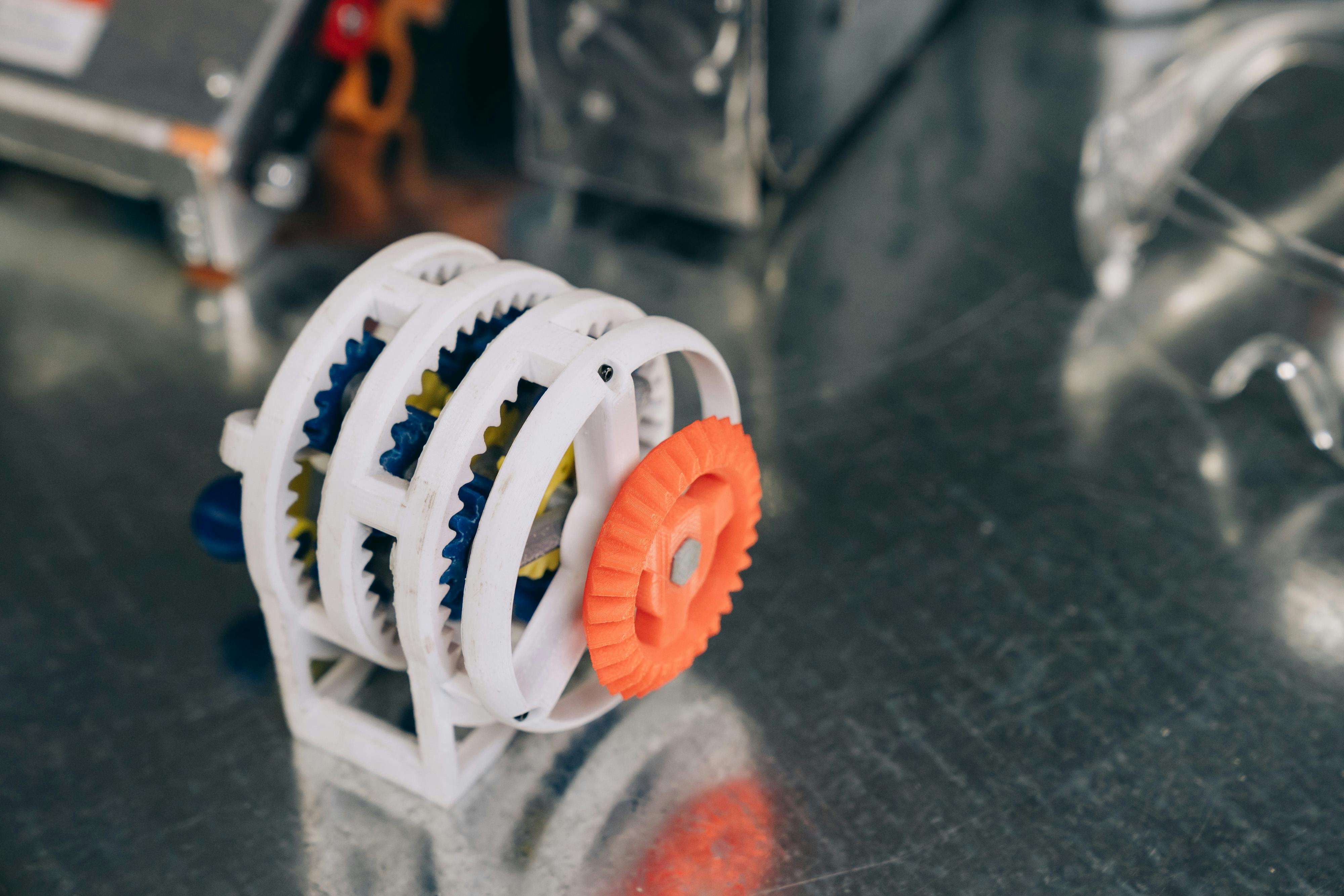
Part consolidation is the clearest path for additive manufacturing to create engineering value. The math behind it is simple: fewer components on the BOM mean fewer suppliers to manage, fewer screws to tighten, fewer interfaces that could leak, and fewer QC stations on the production line. A textbook example is GE Aviation's LEAP fuel nozzle, which went from a 20-piece brazed assembly to a single DMLS printed part, reducing weight by 25% and increasing durability fivefold. This single part alone makes a stronger investment case for metal printing than any white paper.
What the title doesn't tell you is: consolidation doesn't happen automatically. After factoring in printing time, post-processing, powder removal, inspection, and the cost of "loss of repairability," only about one in four candidate assemblies actually pay off. The discipline – and commercial leverage – lies in identifying which assemblies belong to that quarter, designing the consolidated part so that it "can actually be made by a powder bed process," and stopping before "consolidation becomes an irreversible project burden."
Why Powder Bed Processes Are Suitable for Consolidation
Traditional manufacturing penalizes complexity. Every undercut requires a set of slides, every internal feature adds a processing step, and every screw adds a drilling and alignment step. Powder bed additive processes are almost the opposite: once the build is laid out, the cost of printing a bracket with internal channels is almost the same as printing a flat plate bracket within the same outer envelope. This asymmetry is the leverage. The most worthwhile assemblies to consolidate are those where the number of parts exists only to circumvent manufacturing limitations – they weren't intentionally designed to be separate, but there was no other process at the time that could make them as a single piece.
Scoring Table for Candidate Assemblies
The quickest way to classify a BOM is to score each multi-part sub-assembly based on five factors and sum the scores. A score of 12 or higher almost certainly pays off; 8–11 points usually pay off with design effort; those below 8 points are best left alone or improved through DFA in the original process. This scoring table has been used on over two hundred candidate assemblies in medical, industrial, and aerospace projects since 2022.
| Factor | 0 Points | 2 Points | 4 Points |
|---|---|---|---|
| Number of Parts | 2–3 parts | 4–8 parts | 9+ parts |
| Assembly Labor as % of Cost | < 15% | 15–40% | > 40% |
| Joints are Main Cause of Failure/Warranty | No record | Occasional | Known as Top 3 Failure Modes |
| Annual Production Volume | > 50,000 | 5,000–50,000 | < 5,000 |
| Repairability Requirements | Must be replaced on-site | Module replacement acceptable | Entire part replacement acceptable |
Matching Consolidation to the Right Additive Process
Consolidation is never a single decision, but rather "a consolidation candidate × a process that can actually produce that geometry." A manifold with 2 mm internal channels is trivial for SLM, impossible for FDM. A large, lightly loaded bracket is trivial for MJF, expensive for DMLS. The table below maps five common consolidation goals to processes that usually win, and indicates the economic breakpoint where traditional assembly becomes competitive again for a single part.
| Consolidation Goal | Recommended Process | Typical Unit Price (USD) | Traditional Break-even Volume |
|---|---|---|---|
| Fluid manifolds, internal channels | SLM / DMLS (Ti, AlSi10Mg, Inconel) | 600 – 3,500 | 40,000+ units |
| Multi-part lightweight brackets | MJF PA12 or CF-PA12 | 45 – 220 | 25,000 units |
| Mold inserts with conformal cooling | DMLS maraging steel / H13 | 900 – 4,200 | Never – cycle savings dominate |
| Patient-specific surgical guides | SLA biocompatible resin | 80 – 260 | Volume is always 1 |
| Drone fuselage sub-assembly | SLS PA12 or CF-SLS | 180 – 780 | 15,000 units |
| Electronics enclosure with integrated channels | MJF PA12 | 90 – 380 | 30,000 units |
Three Cases of Successful Consolidation
A 27-Piece Hydraulic Manifold Collapsed into a Single SLM Titanium Print
A hydraulic control manifold for an off-road vehicle supplier consisted of 27 machined parts with O-rings. The field leakage rate was 1.4%, which, with an annual production of 4,800 units, burned USD 610,000 in warranty returns and USD 180,000 in field labor annually. Traditional consolidation using large machined parts couldn't eliminate the leakage issue – the O-ring interfaces remained.
The decisive design action was: The engineering team stopped thinking of the manifold as "a block with holes," and instead envisioned it as "a network of smooth-walled channels that a powder bed machine would trace directly." They used CFD to design the channels with a minimum bend radius of 3 mm, replacing 90-degree cross-drilled holes, and added 4 mm drain ports that also served as powder removal channels, leaving only the O-ring grooves and three mating surfaces for post-processing. The final SLM Ti-6Al-4V part was 62% lighter than the machined assembly.
The unit printing cost was USD 2,800, compared to USD 1,150 for machining and assembly, a 2.4x premium. However, the leakage rate dropped to 0.08%, warranty exposure decreased from an annual USD 610,000 to USD 36,000, and assembly time went from 38 minutes per unit to 4 minutes of finishing work. For 4,800 units a year, the net project cost decreased by USD 640,000.
A 9-Piece Drone Fuselage Front Section Printed as a Single CF-SLS Nose Cone
An industrial inspection drone's nose cone, consisting of 9 injection-molded and CNC-machined parts, secured the gimbal, forward IMU, and two antenna bases. Annual production was 2,100 units. The consolidated CF-SLS PA12 nose cone cost USD 340 per unit, compared to the original assembled cost of USD 265, a premium of USD 75 – but it eliminated a 22-minute assembly station, reduced fuselage weight by 140g (improving endurance by 5.2%), and reduced gimbal alignment rework rate from 11% to under 1%. The project's four-year NPV improved by USD 1.4M.
A Surgical Retractor Guide Shed Its Last Four Screws
A neurosurgical retractor used a patient-specific guide, made of four machined PEEK parts secured by titanium Phillips head screws. Sterilization validation required swabbing the four screw recesses; two hospitals had listed these recesses as contamination risks. The instrument manufacturer switched to a single SLA biocompatible resin print, costing USD 180 per unit, compared to USD 240 for the assembled version. More importantly, this single-piece design passed sterilization audits after Q3 2024 – the assembled version barely passed last time. Annual production is 1,800 units; the eliminated clinical risk is simply unquantifiable in spreadsheets.
Design Considerations Separating Success from Failure
Integrated parts can fail in predictable ways. Almost every project's first SLM manifold will have trapped powder; the first MJF integrated bracket, despite data sheet claims, will warp during cooling; the first integrated housing will have internal features that no one can inspect. The "do's and don'ts" below compile the rules that emerged from these projects after their initial failures.
| Do's | Don'ts |
|---|---|
| Design every enclosed cavity with a minimum 4 mm drain/cleaning port | Trust the CAD model when there's no powder escape path visible |
| Keep SLM internal channels above 2 mm, MJF above 3 mm | Assume the same flow rate when shrinking traditional channels |
| Leave 0.5 mm CNC machining allowance for critical mating surfaces | Attempt to achieve tolerance on as-printed sealing surfaces |
| Respect the build space; split into two inter-printable parts if needed | Consolidate beyond the build volume, paying 2x the price for specialized equipment |
| Print a test coupon with the same wall thickness before the first hero part | Skip wall thickness testing and validate directly with CAD submission |
| Include the cost of "entire part replacement" for repairability in the design score | Consolidate field-replaceable modules into non-field-replaceable ones |
Common Mistakes and How to Avoid Them
| Mistake | Why it Fails | How to Avoid |
|---|---|---|
| Consolidating the cheapest assembly first | Assembly labor was already low; won't pay off | Prioritize by labor percentage and failure cost, not part count |
| Using old machined channel dimensions for internal channels | Sharp turns at cross-drilled intersections are impossible to print | Redesign flow paths with a minimum 3 mm radius and perform CFD checks |
| Skipping powder removal planning | Trapped powder increases weight, fails vibration tests, blocks flow | Design drain ports in every enclosed cavity from day one |
| Directly printing sealing surfaces as-built | 8–12 µm Ra surface roughness will leak with O-rings | Leave machining allowance and post-process critical sealing surfaces |
| Consolidating field-replaceable modules | Cost of replacing the entire part soars when a single feature fails | Retain field-serviceable interfaces as separate parts |
| Skipping wall thickness testing | The first hero part warps, delaying the project by 3–4 weeks | Print a 40 × 40 mm coupon with the same wall thickness before any hero part |
When Consolidation Is No Longer Worthwhile
Every consolidation has a ceiling. The table below summarizes three derived from recent projects: a production volume threshold – beyond which injection-molded assemblies directly win on unit cost; a size threshold – beyond which no build chamber can accommodate; and three earlier termination signals than these thresholds.
| Limit | Threshold | What to Do Instead |
|---|---|---|
| Annual Production Volume | Plastics > 150,000; Metals > 30,000 | Use family molds or multi-shot integration; only print for pilot production |
| Part Size | Plastics > 400 × 400 × 400 mm; Metals > 250 × 250 × 300 mm | Split into inter-printable parts or use large-format hybrid processes |
| Field Repairability | Module must be replaced within 5 minutes | Retain as modular assembly; only consolidate non-repairable core |
| Cost Sensitivity | Target fully loaded unit cost < USD 30 | Traditional stamping + snap-fit assembly |
| Material Specification | Requires color matching within Pantone 2 ΔE | Print structural core, overmold or paint exterior shell |
Consolidation Checklist
- Candidate assembly scores 12+ on the "Volume × Labor × Failure × Repair" scoring table
- Target additive process has been specified, and the build space accommodates the consolidated geometry
- Every enclosed cavity in CAD has at least one 4 mm drain/powder removal port
- Internal channels meet process minimums (SLM 2 mm, MJF 3 mm), and have no sharp bends smaller than 3 mm radius
- Critical sealing and mating surfaces are marked for post-processing, leaving 0.5 mm allowance
- Wall thickness test coupon corresponding to the integrated part's thinnest wall has been printed and passed
- Repair strategy has been defined: entire part replacement is acceptable, otherwise that feature is not consolidated
- Total landed cost model has compared printed + finishing costs against assembled parts over a three-year production forecast
Key Design Takeaways
Part consolidation through additive manufacturing offers the highest value when the number of assembly components is a symptom of manufacturing limitations, not intentional modular design. First, score candidates, then match the geometry to a process that can truly produce it. Design drain ports and machining allowances from day one, and stop at the volume or size thresholds where other processes will win. The teams quietly building an advantage in additive by 2026 won't be those printing the most parts, but those who choose four to five consolidations for each product line and leave the rest alone.


0 comments