
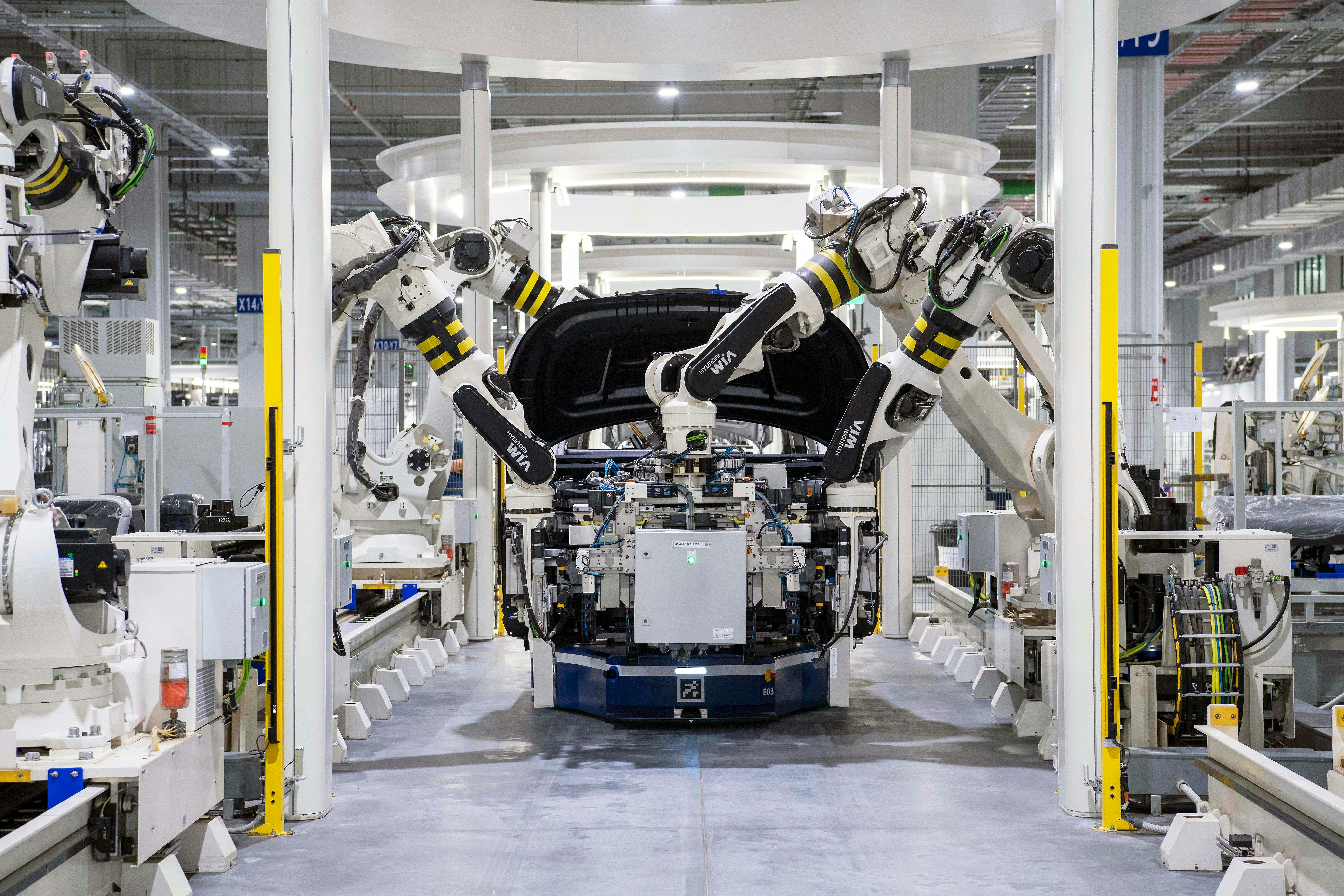
One mid-sized EV project we supported, targeting 1,840 kg, came in at 1,912 kg at its first structural freeze—72 kg over, enough to shave 18 km off WLTP range or force an increase in battery cells, adding USD 380 per car. The team didn't find the weight back with a single hero part. They found 9 kg in a redesigned aluminum rear shock tower, 6.4 kg in four die-cast suspension knuckles, 11 kg by consolidating 43 stamped parts into one gigacast underbody, and another 46 kg scattered across various brackets, heat shields, and wiring harnesses, each saving 40 to 300 grams. Automotive lightweighting in 2026 isn't a one-time material swap; it's an accounting exercise measured in kilograms, driven by CAFE, Euro 7, or China CAFC fuel economy/range targets, with every decision priced by "how many dollars per kilogram saved."
Regulatory Pressure Driving Every Gram
US CAFE requires a fleet average of 49 mpg by MY2026, EU fleet CO2 limits drop to 93.6 g/km by 2025 and aim for zero by 2035, and China's Phase 6 CAFC caps fleet fuel consumption at 4.6 L/100 km. For a 1,500 kg sedan, every 10 kg reduction roughly translates to 0.1 L/100 km or 2.3 g/km CO2. OEMs missing EU targets face fines of EUR 95/g/km/vehicle. A 1 g/km difference for a platform with 400,000 units means an annual fine of EUR 38 million—this is why an aluminum tailgate costing USD 120 can economically outperform a USD 45 steel tailgate across the entire project.
| Regulatory Target/Limit | Effective | Penalty Structure |
|---|---|---|
| US CAFE (NHTSA) fleet average 49 mpg | MY2026 | USD 14 per 0.1 mpg per vehicle |
| EU CO2 fleet 93.6 g/km (passenger cars) | 2025 | EUR 95 per g/km per vehicle |
| EU CO2 fleet tailpipe to zero | 2035 | Registration of ICE vehicles prohibited |
| China Phase 6 CAFC 4.6 L/100 km | 2025 | Credit system, NEVs eligible for offsets |
| UNECE R100 (EV) battery safety & quality declaration | In effect | Cannot obtain type approval if not compliant |
Trade-offs Between Steel, Aluminum, Magnesium, and Composites
Material substitution is the lever most projects reach for first, but the correct answer depends on where the part sits in the car, what loads it bears, and production volume. A 0.4 kg bracket hidden in the dashboard can accept a weight-saving cost of USD 8/kg; the same number applied to a 9 kg suspension arm would wipe out the profit margin of an entry-level car.
| Material | Density (g/cc) | Part cost per kg | Weight reduction vs. mild steel | |
|---|---|---|---|---|
| Mild Steel | 7.85 | USD 1.8–2.4 | Baseline | Low-stress panels |
| AHSS/UHSS | 7.85 | USD 2.6–3.4 | 15–25% | B-pillar, rocker panel, bumper beam |
| 6xxx Aluminum | 2.70 | USD 5–7 | 40–50% | Hood, doors, fenders |
| Aluminum HPDC | 2.70 | USD 6–9 | 35–45% | Shock towers, gigacasting |
| Magnesium AM60 | 1.80 | USD 9–13 | 55–65% | Instrument panel beam, seat frame, steering wheel |
| GF-PA/PP | 1.10–1.40 | USD 4–6 | 50–60% | Engine compartment, HVAC, door trim panel liners |
| CFRP (RTM) | 1.55 | USD 35–65 | 55–65% | Roof, structural halo, luxury exterior panels |
Matching Process, Part, and Volume
Process economics collapse when volume and part size are mismatched. Gigacasting only makes sense above 80,000 units/year because the USD 6-12 million mold plus the 6,100-ton press can only be amortized at scale. Topologically optimized DMLS brackets can win below 1,500 units/year because you completely eliminate the mold. The table below shows the real decision points our process engineers use.
| Process | Feasible Volume | Part Size | Typical Weight Range | Tooling Cost |
|---|---|---|---|---|
| DMLS/LPBF | 50–2,500/year | <400 mm | 0.2–3 kg | None |
| Sand Cast Aluminum | 500–25,000/year | <1,200 mm | 2–40 kg | USD 15k–80k |
| Aluminum HPDC | 40,000+/year | <900 mm | 0.5–25 kg | USD 250k–900k |
| Gigacasting (HPDC) | 80,000+/year | 1.5–2.2 m | 60–130 kg | USD 6M–12M |
| Hot Stamped UHSS | 100,000+/year | <1.8 m | 1–12 kg | USD 400k–1.2M |
| Hydroformed Tubes | 50,000+/year | <3 m | 1.5–8 kg | USD 200k–600k |
| RTM CFRP | 5,000–50,000/year | <2.5 m | 1.5–15 kg | USD 300k–1.5M |
Where Weight Savings are More Valuable
Not all grams are created equal. A kilogram removed from unsprung mass (wheels, brake discs, suspension arms) has 3 to 5 times the effect on ride comfort and handling compared to sprung mass. A kilogram removed from the body-in-white triggers secondary savings: smaller brake discs, lower spring rates, and sometimes even a smaller alternator.
| Weight Pool | % of Curb Weight | Secondary Savings Factor | USD Value per 1 kg saved |
|---|---|---|---|
| Unsprung (Wheels, Brakes) | 4–6% | 3.0–5.0x | USD 14–25 |
| Body-in-White | 25–27% | 1.4–1.8x | USD 6–12 |
| Powertrain/Battery Pack | 18–32% | 1.3–1.6x | USD 8–18 |
| Closures (Doors, Hood, Tailgate) | 8–10% | 1.1–1.2x | USD 5–9 |
| Interior/Trim | 14–18% | 1.0x | USD 2–4 |
| Chassis Subframe | 6–8% | 1.5–2.0x | USD 7–14 |
Topology Optimization and Additive Design without Buzzwords
Topology optimization is not magic—it's an FEA solver that removes areas below a stress threshold under defined load cases. The trap lies in the load cases. A bracket designed with only a single static pull load case will break in a real-world environment with bending and vibration. All topologically optimized parts we've mass-produced used at least three load cases: the most severe static, 1e6 cycle fatigue, and a crash pulse when necessary. Skip any of these, and a 38% weight reduction turns into a warranty claim.
Control Arm Redesign Saves 1.4 kg per Corner
A Tier-1 supplier producing 180,000 forged steel lower control arms annually ran three load cases for a redesigned cast aluminum part with an internal rib structure—3.5 g vertical bump, 2.0 g lateral cornering, and 1.3e6 cycles of fatigue. Mass per corner dropped from 4.8 kg to 3.4 kg, saving USD 4.20 in material per part. The USD 680,000 tooling cost was recouped within nine months through gross margin contribution. The truly important design action: they locked the three bushing mounting points as non-design space before letting the solver work. The second consideration was manufacturability: the solver's first output had a 2.1 mm rib in a certain area, and casting simulation showed it wouldn't fill. The team added a minimum thickness constraint of 3.2 mm and re-ran; mass increased by 90 g, but the part cast cleanly on the first trial. The ultimate lesson: topological results are initial geometry, not final parts.
DMLS Replaces 16 Welded Tubes for Cooling Manifold
In a 340 kW performance EV, the welded stainless steel cooling manifold weighed 3.1 kg, with a 17% warranty leakage rate within 150,000 km for its welds. Redesigned using LPBF with AlSi10Mg, it was consolidated into a single 1.05 kg part with conformal internal flow paths, improving pump-side pressure drop by 22%. Tooling cost was zero; part cost was USD 340, compared to USD 118 for the old manifold, but warranty reserves released covered the difference within 14 months of production.
Magnesium Alloy Seat Frame Passes FMVSS 207
A front seat frame made from thixomolded AM60 magnesium alloy replaced the original 11.2 kg steel tube and stamped assembly, weighing 6.8 kg per piece. It passed FMVSS 207 seatback strength of 1,330 N-m with a safety factor of 1.9. Two front seats saved a total of 8.8 kg per car. Each seat added USD 42. At an annual production scale of 280,000 units, CO2 compliance credits covered the cost in the first model year.
Mixed-Material Joining is the Real Engineering Challenge
Whenever a body structure changes from all-steel to steel, aluminum, and composites, the number of joining points triples, and the warranty footprint expands accordingly. Aluminum cannot be spot welded to steel—electrochemical corrosion will eat it away within 40,000 km. Self-piercing rivets (SPR), flow drill screws (FDS), structural adhesives, and friction stir welding each have different cycle times, costs, and inspection regimes. Plan the joining stack before the BOM, not after.
| Joining Type | Application | Cycle Time per Joint | Cost per Joint | |
|---|---|---|---|---|
| Resistance Spot Welding | Steel-to-steel | 0.8–1.4 sec | USD 0.03 | Destructive sampling |
| SPR | Aluminum-to-aluminum, aluminum-to-steel, mixed materials | 1.2–2.0 sec | USD 0.11 | Visual inspection + cross-sectioning |
| FDS | Single-sided access only | 2.5–3.5 sec | USD 0.18 | Torque + depth |
| Structural Adhesive | Any combination, including sealing | Cure 20–40 min | USD 0.06–0.12/cm | Peel test specimens |
| Friction Stir Welding | Aluminum-to-aluminum structural parts | 400–800 mm/min | USD 0.22/cm | Ultrasonic |
| Laser Brazing | Aluminum closures for aesthetics | 60–80 mm/s | USD 0.14/cm | Visual |
Lightweighting Mistakes We See Every Quarter
| Mistake | Why it Fails | How to Avoid |
|---|---|---|
| Changing to aluminum without re-running crash simulations | Energy absorption paths change; intrusion increases by 18–40 mm | Re-run full FMVSS 214 and Euro NCAP side pole before tool release |
| Directly copying steel rib designs to cast aluminum | Unbalanced wall thickness ratios lead to shrinkage porosity | Apply casting design rules: uniform wall thickness of 3–5 mm, ample fillets |
| Sending topological results directly to DMLS | No support strategy; warping | Allocate 2 days for DfAM cleanup and orientation study |
| Mixed-material joining without corrosion protection plan | Electrochemical corrosion appears within 2 years in salty regions | Specify e-coat + insulation + sealing for every aluminum-steel interface |
| Weight budget set at part level instead of subsystem level | Teams compete for grams they can't achieve | Cascade from full vehicle target to subsystems, then to parts |
| Selecting CFRP solely based on weight | Repair cost triples; resale value drops by 12% | Unless volume is high, limit CFRP to non-crash path panels |
Design Habits That Pay Back in Mass
| Do | Avoid |
|---|---|
| Freeze subsystem mass budgets before CAD starts | Let teams chase grams in their own silos |
| Price every decision by USD/kg saved | Celebrate weight victories that cost more than they saved |
| Validate topology optimization with at least 3 load cases, including fatigue | Ship with only a single static load case |
| Involve Tier-1 joining engineers at the concept stage | Select materials first, then think about joining |
| Value unsprung mass 3x higher | Treat all kilograms in the car equally |
| Verify casting fill simulation before tooling | Assume topological ribs can be cast if FEA says so |

Lightweighting Checklist Before Tool Release
- Subsystem mass budgets are cascaded from vehicle targets and signed off by owners.
- Every structural component is benchmarked and priced by USD/kg saved.
- Topology optimization results are validated under at least three load cases (including fatigue).
- Casting or additive simulations have been run with the actual CAD sent for tooling.
- Joining stacks and corrosion protection plans are documented for every mixed-material interface.
- Any material changes have been followed by re-running FMVSS 214 and Euro NCAP side pole simulations.
- Unsprung mass items are weighted 3x in the mass decision matrix.
- Any process change with more than 20% new content has simulated warranty reserve differences.
Design Focus
Automotive lightweighting in 2026 rewards teams that treat mass as currency, not just a target. Every gram carries a regulatory price, material price, process price, and warranty price. Winning projects put these prices in front of designers the moment geometry is being sketched. Choose the right process for the volume, build mass budgets before part budgets, and refuse to ship topological results without casting simulation or DfAM cleanup. Your project's 72 kg overweight is almost always made up of 200 decisions, each weighing 300 grams.


0 comments